
Quick Summary
Should I do a Roth conversion in retirement? Possibly—but the right answer depends on your current and future tax rates, cash flow, Medicare timing, charitable goals, and how long the money may remain invested. At Purposeful Money, I use my experience as a CFP® professional and Enrolled Agent to help women over 55 and couples make Roth conversion decisions in plain English, with coordinated, multi-year planning rather than an all-or-nothing tax move.
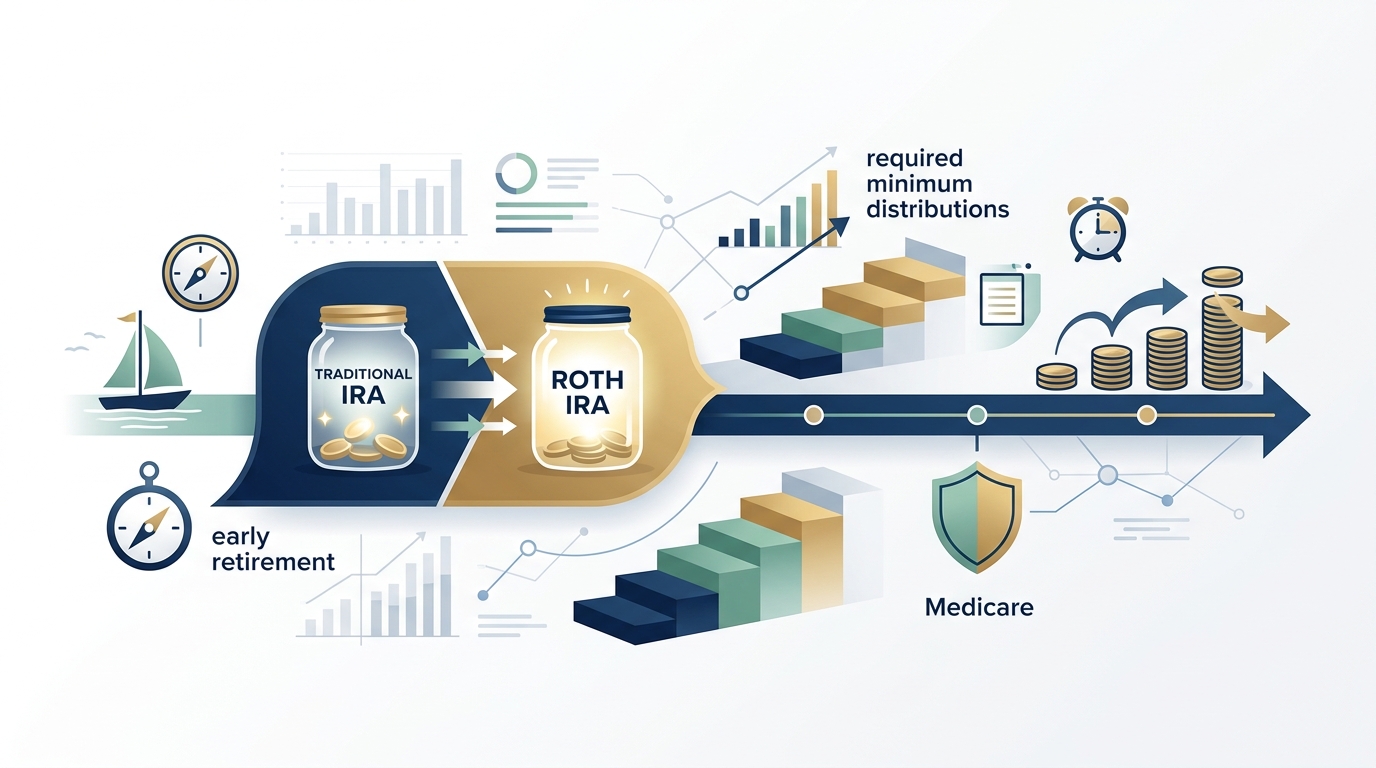
A Roth conversion means moving money from a pre-tax retirement account, such as a traditional IRA, into a Roth IRA. The converted amount is generally included in your taxable income for the year of the conversion, but future qualified Roth withdrawals may be tax-free. That tradeoff can be valuable—but only when it supports the bigger picture of your retirement, your lifestyle, and the purpose you want your money to serve.
The Early-Retirement Planning Window
For many newly retired households in Southwest Florida, the most promising conversion window falls after paychecks stop and before required minimum distributions, or RMDs, begin. Under current 2026 rules, RMDs generally begin at age 73 for people born from 1951 through 1959 and at age 75 for people born in 1960 or later.
Those years can create a meaningful planning opportunity. Your taxable income may be lower before RMDs, pensions, Social Security, or large capital gains fully shape your tax picture. Rather than waiting until large mandatory IRA withdrawals arrive, you may be able to move a measured amount to a Roth IRA during years when your federal tax bracket is more manageable.
This is one reason retirement tax planning is not simply about filing a return each spring. It is about looking ahead: How will your income change? When will you claim Social Security? What will RMDs look like? What spending, travel, giving, or family goals matter most to you? Those answers shape whether a conversion has a useful role in your retirement income plan.
Think in Tax Brackets, Not One Big Conversion
A Roth conversion does not need to be all or nothing. In fact, a common approach is to decide how much of a chosen federal tax bracket you are comfortable using each year, then convert only enough to reach that target.
For 2026, the federal ordinary-income brackets for married couples filing jointly are 10% up to $24,800 of taxable income, 12% up to $100,800, 22% up to $211,400, and 24% up to $403,550. For single filers, those thresholds are $12,400, $50,400, $105,700, and $201,775, respectively. These brackets apply to taxable income—not simply the amount of your conversion—and the standard deduction, other income, deductions, and filing status all matter.
I encourage clients not to view a 22% or 24% bracket as automatically good or bad. The important question is whether paying a known tax rate now is likely to be better than the federal tax rate you may face later. At Purposeful Money, I prefer to model several years at once, including projected RMDs, Social Security, portfolio withdrawals, and potential survivor income changes. This approach can help us avoid bracket creep rather than accidentally creating it.
You can learn more about how tax decisions fit into the larger picture through Tax Planning & Preparation.
Medicare IRMAA Can Make Timing Important
If you are on Medicare—or will be soon—conversion income can have another consequence: IRMAA. IRMAA is the income-related monthly adjustment amount that can increase Medicare Part B and Part D premiums for higher-income households.
The important timing detail is that Medicare generally uses your modified adjusted gross income from two years earlier. In other words, a Roth conversion completed in 2026 may affect Medicare premiums in 2028. A conversion that looks reasonable based solely on your income-tax bracket could become more expensive if it pushes you across an IRMAA threshold.
That does not mean you should never cross an IRMAA threshold. Sometimes a modest surcharge may be worth it if the conversion meaningfully reduces future RMDs or creates more flexibility later. But it should be intentional. Medicare guidance for retirees belongs in the same conversation as tax planning, Social Security planning, and your retirement cash-flow needs.
The Roth IRA Five-Year Rules Are Not All the Same
The phrase “five-year rule” is often used as though there is only one Roth IRA rule. In reality, there are distinct clocks, and they can affect different withdrawals in different ways.
First, for Roth IRA earnings to be distributed tax-free, you generally need to satisfy a five-tax-year holding period that begins with your first Roth IRA contribution or conversion, and you generally must also be age 59½ or meet another qualifying condition. Second, each Roth conversion has its own five-year period for the 10% additional tax on converted amounts withdrawn before age 59½, with important ordering rules and exceptions.
For many retirees over 59½, the penalty rule may be less of a practical concern. Still, age, account history, conversion timing, and the source of a withdrawal matter. If you may need converted funds soon, have recently opened your first Roth IRA, or are planning around a spouse’s account, please do not assume the rules are automatic. This is an area where careful coordination can prevent avoidable surprises.
Florida Helps, but Federal Tax Still Applies
Living in Florida can be an advantage in a Roth conversion comparison because Florida does not impose an individual state income tax. Unlike a resident of a state with a significant income tax, you generally do not add state income tax to the current cost of converting while you remain a Florida resident.
That said, Florida’s tax treatment does not make a Roth conversion tax-free. The converted amount is still generally subject to federal income tax, and it may affect Medicare premiums, Social Security taxation, deductions, and other parts of your return. It is also worth considering whether you might relocate later to a state with an individual income tax. Retirement planning in Naples and throughout Southwest Florida should account for both today’s residence and the life you envision in the years ahead.
Social Security Can Change the Math
Once Social Security benefits begin, additional ordinary income from a Roth conversion can increase the portion of your benefits subject to federal income tax. Depending on your provisional income, up to 85% of Social Security benefits may be taxable. That does not mean your full benefit is taxed at 85%; it means up to 85% of the benefit may be included in taxable income.
This interaction is why Social Security claiming strategies and Roth conversion decisions should not be made in separate silos. The timing of when to claim Social Security, whether one spouse continues working, planned withdrawals, and conversions can all affect the tax result. For couples, it is particularly important to look at the survivor’s situation, since the surviving spouse may later file taxes using single brackets while still receiving much of the household’s income.
When a Roth Conversion May Not Make Sense
A Roth conversion is a planning tool, not a requirement. I may recommend slowing down, reducing the conversion, or avoiding it when the numbers and your priorities do not support it.
- You would need to use IRA funds to pay the conversion tax, reducing the amount that reaches the Roth and potentially creating additional tax consequences.
- You reasonably expect to be in a meaningfully lower federal tax bracket later.
- A conversion would place you just over a Medicare IRMAA threshold with little offsetting long-term benefit.
- Charitable giving is central to your plan and qualified charitable distributions from an IRA after age 70½ may be more valuable for meeting your giving and tax goals.
- You may not have enough time for the long-term benefits to outweigh the upfront federal tax cost.
- You have high-interest debt, thin cash reserves, or near-term spending needs that deserve attention first.
A thoughtful plan can include some conversion years and no-conversion years. It can also involve converting less than the maximum amount your tax bracket technically allows. My goal is not to force a strategy. My goal is to help you make decisions that support a confident, meaningful retirement.
Roth Conversions Are Part of a Purpose-Driven Plan
At Purposeful Money, I believe good financial planning for women over 55 is about more than reducing a projected tax bill. It is about building a plan around your Season of You™—the life transition you are navigating, the people you care about, and the freedom you want your money to provide.
That may include investment management aligned with your retirement goals, estate planning coordination, charitable giving, health-care costs, insurance decisions, and the question so many people quietly carry: “Do I have enough to retire the way I want?” A Roth conversion can create flexibility for future spending and legacy planning, but it works best when it is connected to your full plan.
My Comprehensive Retirement Planning
process brings these decisions together in a judgment-free, plain-English way. We can compare different conversion amounts, account for your projected taxes and Medicare costs, and revisit the strategy as tax rules, markets, and life change.
FAQ
Can I convert only part of my traditional IRA to a Roth IRA?
Yes. You can generally convert a portion of a traditional IRA rather than the entire account. Partial conversions are often useful for managing taxable income and staying within a chosen tax bracket or Medicare premium range.
Do I have to be retired to do a Roth conversion?
No. A Roth conversion can be available before retirement as well. However, the lower-income years after retirement and before RMDs often provide a clearer planning opportunity for people whose earned income has declined.
Will a Roth conversion reduce my future RMDs?
It can. Amounts moved from a traditional IRA to a Roth IRA are no longer included in future RMD calculations for the original owner. The conversion itself is taxable, so the value of reducing future RMDs should be weighed against the cost of paying tax now.
Can I undo a Roth conversion if I change my mind?
Generally, no. Roth conversion recharacterizations are no longer permitted, so it is important to estimate the tax impact and confirm that you have a plan for paying any resulting tax before completing the transaction.
Does Florida’s lack of state income tax mean I should always convert?
No. Florida’s lack of individual state income tax can improve the comparison, but federal income tax, Social Security taxation, Medicare IRMAA, cash flow, charitable intentions, and your expected future tax rate still matter.
Let’s Model the Decision Before You Move Money
You do not need to navigate Roth conversions with a spreadsheet, a headline, or a one-size-fits-all answer. If you are a woman over 55 or part of a couple in Southwest Florida who wants a clear, coordinated view of retirement taxes, income, Medicare, and the life you want next, I would be glad to help.
Schedule Your Learn More Call with Purposeful Money at 800-520-9793
or https://www.purposefulmoney.com/contact. We will start with your questions and build from there.
Educational information only. This article is not individualized tax, legal, investment, or financial advice. Tax laws, tax brackets, Medicare IRMAA thresholds, and other rules can change, and results depend on your personal circumstances. Please coordinate decisions with qualified tax and financial professionals before completing a Roth conversion.
Read More Articles
Roth Conversion Strategy in Retirement: When It Makes Sense and When It Doesn't

What Is an Enrolled Agent — and Why Should Your Retirement Advisor Be One?

The Hidden Tax Traps in Retirement — and How to Avoid Them
Read more
The Long Run Retirement Method: A Holistic Approach for Women Navigating Retirement in Southwest Florida
Read more
What the September Fed Meeting Means for Retirement Plans

Why a One-Time Financial Plan Fails Retirees — and What Ongoing Planning Really Requires

What Comprehensive Retirement Planning Really Means for Women in Southwest Florida

Inheritance Planning and Tax-Smart Financial Decisions

Why Fee‑Only Financial Advice Matters for Women Approaching Retirement

How to Know If Your Financial Advisor Is Truly a Fiduciary (A Guide for Women Retiring in Naples & Southwest Florida)

What it means to work with a fee-only fiduciary financial advisor — and why that distinction matters deeply for women approaching retirement

When Claiming Social Security Early Can Actually Help Women Retiring
Read more
5 Common Retirement Planning Mistakes (and How to Avoid Them)

Understanding Accelerated Death Benefit Riders

Maximize Your IRA and HSA Contributions Before Tax Day Arrives

Understanding Long-Term Care Riders in Your Life Insurance Plan

Retirement Planning Strategies for Adults Managing Student Loans

A Fresh Start for Your Finances: Your January Guide to Building Financial Wellness

December 2025 Market Recap: A Year’s Final Turn

Turkey Talk: 5 Financial Questions Advisors Often Hear

What's in my wallet?

Exploring Major Types of Investment Vehicles

5 Key Economic Terms Simplified for Your Financial Insight

Back-to-School Money Moves: A Financial Game Plan

Check In with Your 2025 Financial Plans Mid-Year

A Grain of SALT in the Big Beautiful Bill

Big Beautiful Bill- What's in it for Who?

Exploring Life Insurance: A Key to Financial Literacy
Navigating Risk Tolerance for Investment Success
Read more
Simplify Annuity Choices for Your Financial Future

Take Charge of Financial Wellness Month 2025

Understanding Adjustable-Rate Mortgages in a Changing Market

Exploring Charitable Giving Options: Maximize Impact and Benefits
Read more